
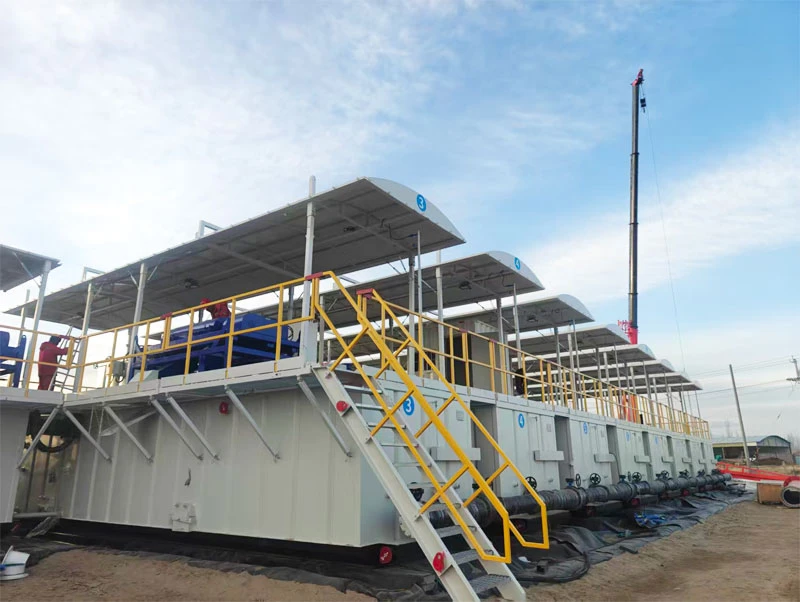
In modern oil and gas drilling, Solids Control Systems (SCS) are critical for maintaining mud integrity. By strategically deploying a multi-stage filtration process, operators can remove harmful drill cuttings while preserving essential weighting agents and chemicals. This ensures the drilling fluid meets the rigorous demands of complex well profiles.
Our high-efficiency 5-stage drilling fluid solids control system workflow ensures superior mud quality and extends equipment longevity.
Phase 1: Shale Shaker (Primary Removal)
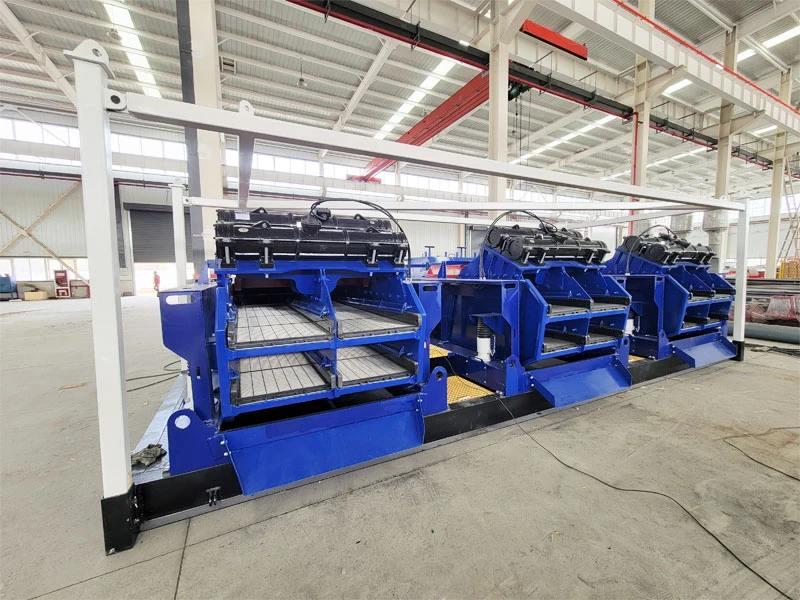
Target: Large cuttings (>74μm) The process begins when the drilling fluid returns from the wellbore via the flow line. It enters the Agitador de xisto, where high-frequency vibration and mesh screens filter out coarse solids. This primary stage is vital for protecting downstream equipment from heavy wear.
Phase 2: Vacuum Degasser (Gas Elimination)
Target: Entrained Air and Gas (H₂S, CO₂, Methane) To prevent “gas-cut” mud, the fluid is processed through a Desgaseificador a vácuo. This stage rapidly extracts intrusive gases that could otherwise reduce mud density, compromise hydrostatic pressure, and lead to dangerous well-control issues like blowouts or wellbore instability.
Phase 3: Desander (Coarse Sand Separation)
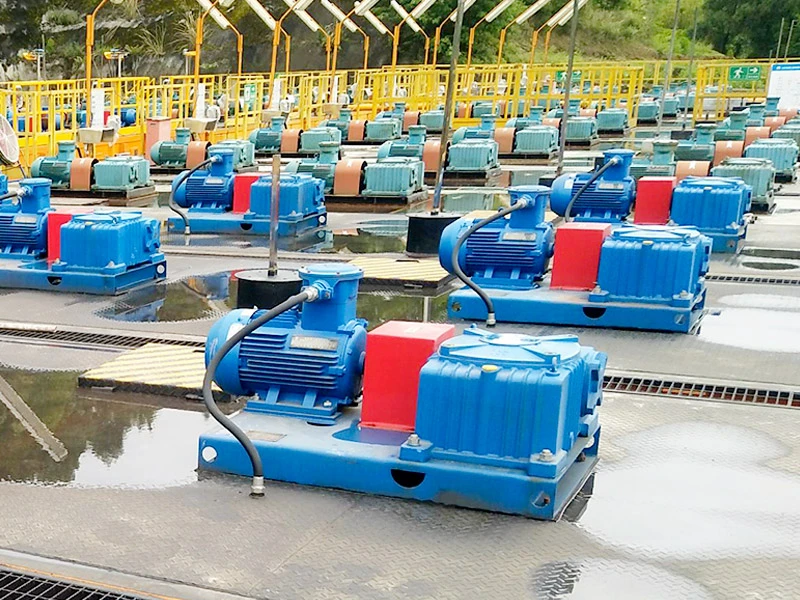
Target: Sand particles (44μm – 74μm) After primary screening, the mud is pumped into the Desander (typically featuring 10″ or 12″ hydrocyclones). Centrifugal force separates medium-sized abrasive solids that are too fine for the shaker but large enough to damage mud pumps.
Phase 4: Desilter (Fine Particle Separation)
Target: Silt and fine solids (8μm – 44μm) The Dessiltro utilizes a bank of smaller (4″) hydrocyclones to handle finer particles. By removing these silts, the system maintains the ideal plastic viscosity and yield point of the drilling fluid, ensuring efficient hole cleaning.
Phase 5: Decanter Centrifuge (Ultra-Fine Recovery)
Target: Ultra-fine solids (2μm – 8μm) The final stage employs a high-speed Horizontal Decanter Centrifuge. This equipment uses extreme G-forces to separate the smallest harmful solids. This stage is particularly crucial for high-density muds and complex drilling environments, as it allows for the recovery of valuable barite while discarding “dead” solids.
Why Use a 5-Stage System?
While simpler wells may only require 2 or 3 stages, the full 5-stage configuration is the gold standard for complex, deep-water, or high-pressure/high-temperature (HPHT) wells.
- Customization: The workflow is modular; stages can be bypassed or activated based on real-time drilling conditions.
- Cost Efficiency: By maximizing the recycling of clean mud, operators significantly reduce the cost of drilling chemicals and water consumption.
- Compliance: This process ensures the mud properties meet international standards for environmental discharge and drilling performance.

 Conversar com o engenheiro