
What is the function of a desander in the drilling mud system?
Desanders in drilling mud systems primarily separate 47-76 micrometer solid particles (such as sand and drill cuttings) from the drilling mud, protecting equipment and stabilizing mud performance.
The function of a desander in the drilling mud system
Removing Sand-Grade Solids: Removes 20-74μm sand particles, preventing them from accelerating wear on drill bits, pumps, and valves, and causing abnormal increases in mud density.
Protecting Drilling Equipment: Reduces mechanical damage to drill bits, pumps, and other equipment caused by sand particles, extending their service life.
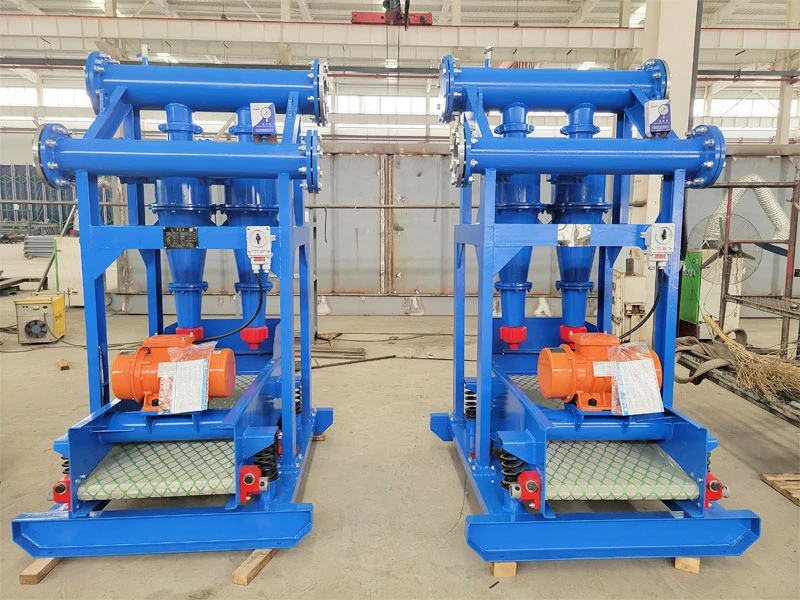
The Core Role of Desanders in the Drilling Process
Optimizing Solids Control System Efficiency: Drilling fluid desanders are an important component of the three-stage drilling mud purification system, typically used in conjunction with vibrating screens. Their primary function is to remove 47-74 micrometer fine sand that vibrating screens cannot remove, effectively reducing the load on subsequent desilters, centrifuges, and other fine processing equipment, preventing overload, and thus ensuring the efficient and stable operation of the entire solids control system.
Maintaining Drilling Fluid Performance and Ensuring Drilling Efficiency: Excessive fine sand solids in drilling fluid directly lead to increased viscosity and shear stress, and decreased fluidity. Desanders effectively control the solids content, maintaining excellent rheological properties of drilling fluids, thereby sustaining high rates of penetration (ROP) and reducing downhole complications such as stuck pipe caused by poor mud performance.
Protecting drilling equipment and extending service life: Fine sand particles in drilling fluids have strong abrasive properties. Continuous operation of the desander significantly reduces wear on critical equipment such as drilling pump cylinder liners, pistons, drill pipes, and drill bits. This is one of the most direct and cost-effective technical measures to extend equipment life and reduce maintenance costs.
Controlling overall costs and improving operational economics: The effective use of desanders directly improves the economics of drilling operations by increasing ROP, reducing equipment downtime for maintenance, and decreasing the frequency of parts replacement. As a primary solids control device in non-weighted drilling fluid systems, it is equally crucial for controlling the overall cost of drilling fluids.
Equipment Features
Material: High-chromium cast iron (high temperature resistant) or polyurethane (wear resistant), service life 2000-4200 hours.
Structure: Multiple hydrocyclones are often connected in parallel (e.g., 6-8 units per group), with a processing capacity of 20-50 m³/h.
 Chat with Engineer