
Centrifuges are core equipment in drilling solids control systems, enabling precise solids control. They primarily separate fine solid particles (typically 2-74µm in diameter) from drilling fluids that conventional solids control equipment (such as shale shakers, desanders, and desilters) cannot remove.
HL Petroleum’s centrifuges excel in drilling solids control systems, ensuring stable drilling fluid performance, protecting drill strings, reducing costs, and supporting environmentally friendly operations through efficient solid-liquid separation. Their technical features, application scenarios, and practical effects all demonstrate the advantages of high efficiency, intelligence, and environmental friendliness.
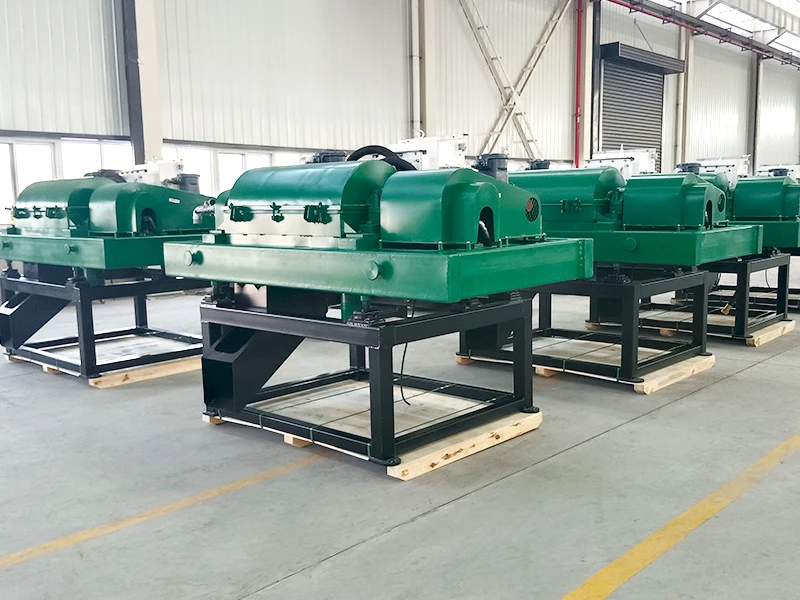
The Core Role of Centrifuges in Drilling Solids Control Systems
1. Solid-Liquid Separation: Centrifuges utilize the centrifugal force generated by high-speed rotation to effectively separate solid particles (such as mud, sand, and cuttings) from the liquid in the drilling fluid. This process is a core component of the solids control system, ensuring the cleanliness and stability of the drilling fluid.
2. Protecting Drill Strings: Impurities and solid particles in drilling fluids easily clog drill bits and drill pipes, affecting drilling efficiency and safety. Centrifuges remove these impurities, protecting drill strings from wear and clogging, and extending their service life.
3. Controlling Drilling Fluid Performance: The performance of drilling fluid (such as viscosity, density, and fluidity) directly affects drilling speed, wall stability, and solidification effect. Centrifuges remove excess plasticizers, particles, and other impurities, stabilizing drilling fluid performance and preventing drilling accidents caused by poor performance.
4. Reducing Costs: Centrifuges filter out solid impurities and sediments from drilling fluid, allowing for fluid reuse and reducing drilling costs. Simultaneously, they reduce waste generation, meeting environmental protection requirements.
HL Petroleum Centrifuge Technical Features
1. High Separation Precision LW450x1000N Horizontal Screw Centrifuge
With a drum inner diameter of 450mm and a length of 1000mm, it generates a separation factor of 1210 times through high-speed rotation at 2200r/min, achieving a single-unit processing capacity of 50m³/h. It can accurately remove harmful fine particles of 2-5µm from drilling fluid, meeting the needs of complex operating conditions such as deep wells and shale gas wells.
Drilling Fluid Centrifuge: Offers multiple models (LW355, LW45O, etc.), with speed ranges from 0-3200 r/min, a separation factor of 2578-2711, and a separation point of 2-5 μm, adaptable to different drilling fluid densities and viscosities.
2. Intelligent Control System
Employs PLC programming and an explosion-proof touchscreen to monitor key parameters such as drum speed, bearing temperature, and overall machine vibration in real time. Supports stepless speed and differential speed adjustment, suitable for complex scenarios such as shale gas wells and high-temperature, high-pressure wells.
In Xinjiang shale gas extraction, the centrifuge, working with a vibrating screen and desander, reuses over 90% of the drilling fluid. This saves approximately 20% of drilling fluid costs per well.
3. Energy-Saving Design
Equipped with a 30kW high-efficiency motor and a lightweight structure, energy consumption is significantly reduced compared to traditional equipment. Combined with a barite recovery function, drilling costs can be saved per well.
Centrifuge Application Scenarios: Covering Multiple Fields and Solving Industry Pain Points
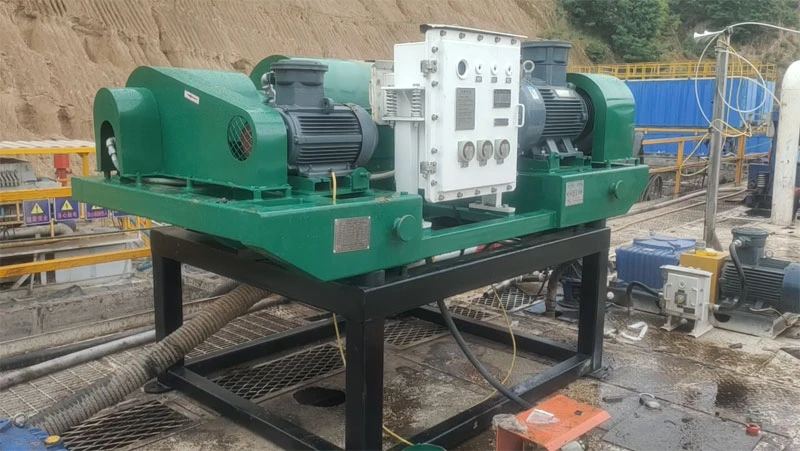
1. Oil Drilling Fluid Treatment
Core Function: As the fourth-stage purification device, it removes colloidal particles, barite, and harmful salts. This controls the drilling fluid’s density and viscosity and ensures stable performance.
Case Study: For the ZJ50 drilling rig’s solids control system, a high-speed centrifuge treats unweighted mud, separating 2-5μm particles. Concurrently, a medium-speed centrifuge recovers barite, ensuring efficient drilling fluid recycling.
2. Trenchless Engineering and Subway Construction
A combined shear pump and centrifuge system can reduce the solids content of mud from 30% to below 5%, ensuring the safety of tunnel boring machine (TBM) construction. For example, in subway construction, this system effectively prevents mud from clogging pipelines and improves construction efficiency.
3. Environmental Protection and Cost Optimization
By reducing the total amount of drilling waste, the cost of subsequent solidification treatment is reduced. For example, HL Petroleum’s integrated solids control system increased mud recovery rate from 65% to 92%, reduced waste disposal costs by 55%, and significantly shortened single-well cycles.
HL Petroleum’s products have served more than 80 countries and regions, covering fields such as oil and gas drilling, trenchless engineering, and building piling, and are highly trusted by customers.

 Chat with Engineer