What Is a Mixing Hopper in Drilling Rig?
A mixing hopper in a drilling rig—also called a Venturi mud hopper or drilling fluid mixing hopper—prepares and treats drilling fluids in oilfield solids control systems, HDD (Horizontal Directional Drilling), trenchless construction, and other drilling operations.
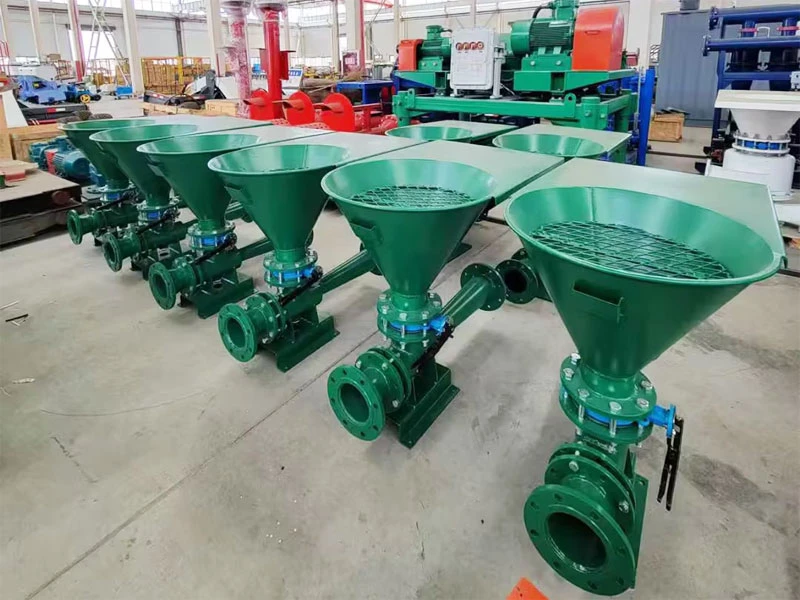
The main function of a mud mixing hopper is to efficiently mix drilling fluid additives such as bentonite, barite, polymers, and other materials into the drilling mud. It helps operators adjust important mud properties, including:
- Drilling fluid density
- Mud viscosity
- Water loss control
- Rheological properties
A complete mud mixing hopper system usually consists of:
- Mixing hopper funnel
- Venturi nozzle
- Mixing chamber
- Shear tube (Venturi tube)
- Butterfly valve
- Sand pump or shear pump
- Connecting pipelines
When combined with a centrifugal sand pump or shear pump, the mud hopper forms a jet mud mixing system, which provides continuous and efficient drilling fluid preparation.
Working Principle of Mixing Hopper in Drilling Rig
The drilling mud mixing hopper works based on the Venturi effect and high-speed fluid jet technology.
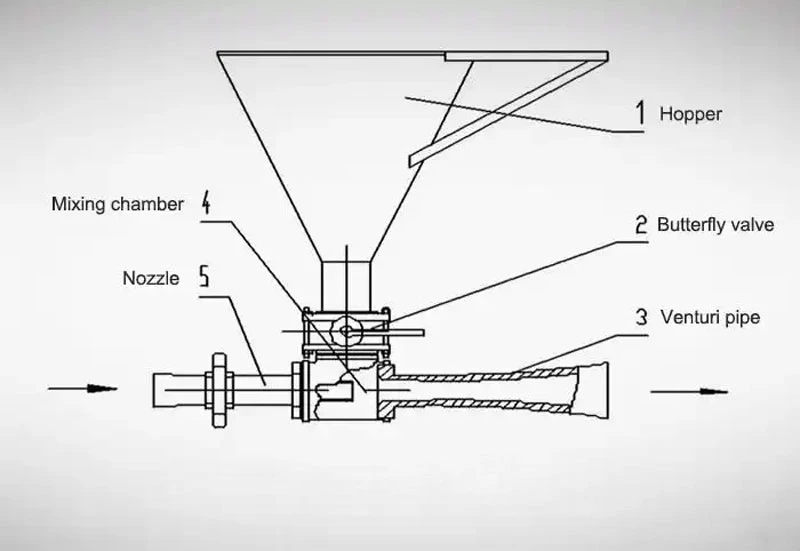
During operation, the sand pump delivers drilling fluid at high pressure into the hopper nozzle. The high-speed liquid jet passes through the nozzle and enters the mixing chamber, creating a low-pressure area around the nozzle outlet.
The pressure difference sucks the solid additives from the feeding hopper into the mixing chamber. Under the impact of the high-speed fluid flow, the additives quickly disperse and mix with the drilling fluid.
After the initial mixing process, the fluid enters the shear tube. Inside the shear tube, strong turbulence and shearing forces further break down particles and improve mixing uniformity. The treated drilling fluid then flows into the mud tank or circulation system for further use.
The whole mixing process can be summarized as:
High-pressure fluid supply → High-speed jet formation → Additive suction → Shearing and dispersion → Uniform drilling mud output
Role of the Venturi Shear Tube
The shear tube is one of the key components of a drilling mud mixing hopper.
It is designed as a gradually expanding pipe with a special internal structure. Its main functions include:
1. Increasing Shear Force
When drilling additives enter the shear tube, the high-speed fluid creates strong turbulence and shear forces. This helps:
- Break up large particles
- Improve additive dispersion
- Prevent material agglomeration
- Enhance mixing efficiency
2. Recovering Pressure
The shear tube uses the principle of fluid dynamics:
High flow speed = Low pressure
Low flow speed = High pressure
At the nozzle outlet, drilling fluid velocity is very high, creating a low-pressure zone that draws materials into the mixing chamber.
When the mixed fluid enters the larger section of the shear tube, the flow speed decreases while the pressure gradually increases. This allows the mixed drilling fluid to be smoothly discharged into the mud tank.
Applications of Drilling Mud Mixing Hopper
Drilling mud mixing hoppers are widely used in various drilling industries, including:
Oil and Gas Drilling
In oilfield drilling operations, mud mixing hoppers are mainly used for:
- Adding weighting materials such as barite
- Preparing drilling fluids
- Maintaining proper mud density
- Improving drilling fluid performance
They are commonly installed as part of a complete solids control system together with shale shakers, desanders, desilters, centrifuges, and mud tanks.
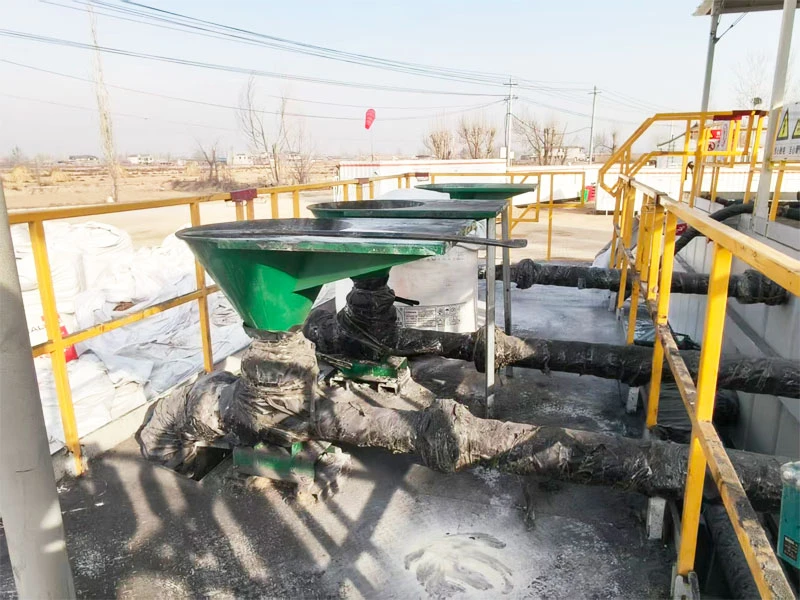
Horizontal Directional Drilling (HDD)
For trenchless construction projects, mud hoppers are used to quickly prepare bentonite mud for:
- Pipeline crossing projects
- Underground utility installation
- Road and river crossing operations
Water Well and Mining Drilling
Mud mixing hoppers also provide an efficient solution for preparing drilling fluids in water well drilling and mineral exploration.
Installation Requirements of Drilling Mud Mixing Hopper
Proper installation is important to ensure stable operation and maximum mixing efficiency.
High-Level Installation
In many drilling mud systems, the hopper is installed on top of the mud tank.
Advantages include:
- Mixed drilling fluid can directly flow into the tank
- No additional lifting equipment is required for the discharged mud
- Reduces pressure loss and pipeline resistance
However, because additives need to be lifted to the hopper platform, operators usually install:
- Hoists
- Lifting frames
- Cantilever cranes
for easier material handling.
Low-Level Installation
When the mud mixing hopper is installed at ground level, the pipeline layout must be carefully designed.
Important considerations include:
- Proper pipeline inclination angle
- Smooth fluid flow path
- Preventing mud overflow
- Ensuring the outlet connects directly to the mud tank
A reasonable installation design can reduce pressure loss and improve mixing performance.
How to Improve Mixing Performance
If the drilling mud mixing effect is not satisfactory, operators can optimize the system by adjusting:
1. Nozzle Position
The distance between the nozzle outlet and the shear tube inlet directly affects the suction force and mixing efficiency.
Proper adjustment can improve:
- Additive feeding speed
- Mixing uniformity
- Mud quality
2. Pump Selection
The performance of the sand pump or shear pump also influences the mixing result.
A suitable pump should provide:
- Stable flow rate
- Sufficient pressure
- Continuous operation capability
3. Pipeline Design
Shorter pipelines with fewer bends can reduce pressure loss and improve overall efficiency.
Advantages of Drilling Mud Mixing Hopper
A high-quality drilling mud mixing hopper provides several benefits:
- Fast preparation of drilling fluids
- High mixing efficiency
- Uniform additive dispersion
- Reduced manual labor
- Simple structure and easy maintenance
- Suitable for continuous drilling operations
- Compatible with oilfield solids control systems
Conclusion
A drilling mud mixing hopper is an essential component for modern drilling fluid preparation systems. By utilizing the Venturi effect and high-speed jet mixing technology, it can efficiently mix drilling additives, improve mud properties, and maintain stable drilling performance.
Whether used in oil and gas drilling, HDD trenchless construction, or other drilling applications, the Venturi mud mixing hopper provides a reliable and efficient solution for drilling fluid preparation and treatment.