In urban subway shield tunneling, pipe jacking, and other underground municipal construction projects, slurry plays an important role in excavation, transportation, lubrication, and ground stabilization. During construction, a large volume of slurry is continuously generated and circulated between the tunneling machine and the slurry treatment system.
However, the slurry flow rate is not always consistent with the processing capacity of downstream equipment. Temporary storage and transfer facilities are therefore essential for maintaining a stable slurry circulation system.
A mud tank, also called a slurry storage tank, provides an effective solution for the temporary storage, buffering, transfer, and management of drilling slurry and construction slurry on shield tunneling and pipe jacking sites.
What Is a Mud Tank for Shield Tunneling?
A shield tunneling mud tank is a steel storage unit designed to temporarily store, collect, and transfer slurry generated during underground construction.
In a typical slurry circulation system, the mud tank acts as a buffer and intermediate storage unit between the tunneling equipment and slurry treatment equipment.
A typical process can be arranged as:
TBM → Slurry Pipeline → Mud Tank → Slurry Pump → Slurry Treatment System → Clean Slurry Tank → TBM
For waste slurry treatment, the process may be:
Construction Slurry → Mud Tank → Slurry Pump → Solid-Liquid Separation Equipment → Waste Treatment
This configuration helps maintain a stable slurry flow and provides additional storage capacity when the slurry generation rate temporarily exceeds the processing capacity of the treatment equipment.
Why Is a Mud Tank Needed for Shield Tunneling?
Urban subway construction usually takes place in areas with limited working space and strict environmental requirements. Proper slurry management is therefore particularly important.
1. Temporary Slurry Storage
Shield tunneling continuously produces and circulates slurry. A mud tank provides temporary storage capacity between different stages of the slurry system.
When the downstream treatment equipment cannot immediately process all incoming slurry, the tank can temporarily hold the excess slurry and prevent overflow.
2. Slurry Flow Buffering
The slurry flow generated by a TBM may fluctuate during excavation.
A properly sized mud tank can absorb short-term fluctuations and provide a more stable feed to:
- Slurry pumps
- Shale shakers
- Desanders
- Desilters
- Decanter centrifuges
- Slurry recycling systems
This helps improve the overall stability of the slurry treatment process.
3. Centralized Slurry Collection
Instead of letting slurry pool across the construction site, contractors collect waste fluid in a dedicated storage tank to maintain a clean, safe work zone.
This provides better control of the construction area and helps:
- Reduce slurry leakage
- Minimize environmental contamination
- Keep the worksite cleaner
- Facilitate slurry recycling
- Simplify slurry transportation
4. Slurry Transfer
A mud tank can also serve as an intermediate transfer station.
A slurry pump or sand pump can transfer slurry from the storage tank to the next processing stage or to another location on the construction site.
Mud Tank Applications in Subway Shield Tunneling
In subway shield tunneling projects, the mud tank integrates directly into the slurry circulation and treatment plant to maintain continuous fluid processing.
A typical slurry treatment process may be:
TBM Excavation
↓
Slurry Return Pipeline
↓
Slurry Storage / Buffer Tank
↓
Slurry Pump
↓
Shale Shaker
↓
Desander
↓
Desilter
↓
Decanter Centrifuge
↓
Clean Slurry Storage Tank
↓
Slurry Pump
↓
TBM
The exact configuration depends on the TBM type, slurry properties, excavation conditions, and required treatment capacity.
For non-recycling projects, operators use the mud tank as a temporary storage unit before hauling waste slurry to a certified treatment facility.
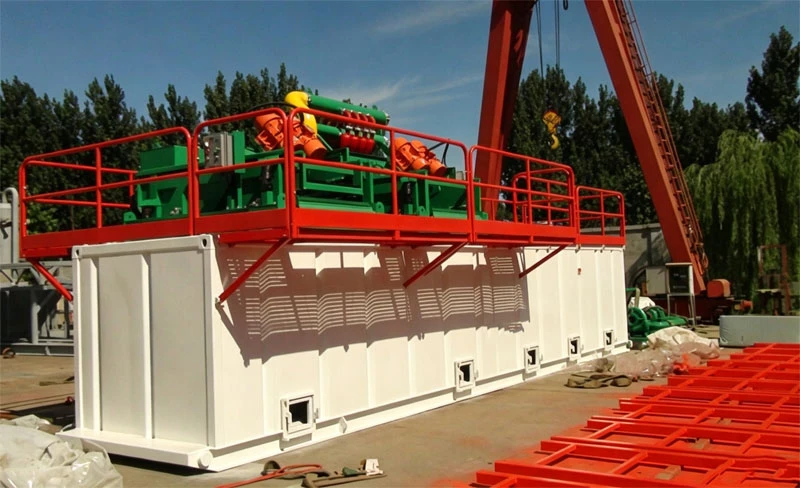
Mud Tanks for Pipe Jacking Projects
In addition to shield tunneling, mud tanks are widely applicable to pipe jacking and trenchless construction.
During pipe jacking, slurry may be used for:
- Lubricating the pipe
- Reducing friction
- Stabilizing the excavation area
- Carrying excavated soil particles
- Improving jacking efficiency
- Supporting slurry circulation
As construction progresses, slurry needs to be continuously collected, transferred, treated, and sometimes reused.
A mud tank can be installed near the working shaft, slurry treatment area, or equipment zone to provide temporary storage.
For long-distance pipe jacking projects, several tanks can also be connected to create a larger slurry storage and circulation system.
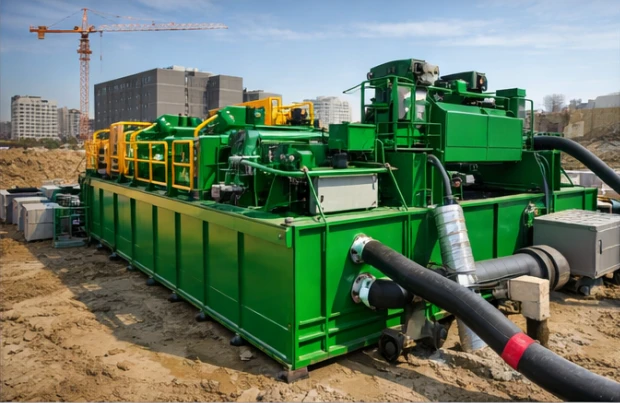
Main Components of a Shield Tunneling Mud Tank
The exact design of a mud tank depends on the project requirements, but a typical unit may include the following components.
1. Steel Tank Body
The tank body is the main slurry storage structure and is generally manufactured from welded steel plates.
The plate thickness and structural design can be selected according to:
- Tank capacity
- Slurry density
- Solid content
- Operating conditions
- Transportation requirements
2. Slurry Inlet
The inlet is connected to the slurry return pipeline or slurry pump.
Its position and size should be designed according to the required slurry flow rate to ensure smooth material entry.
3. Slurry Outlet
The outlet is normally connected to a slurry pump or transfer pipeline.
It allows stored slurry to be continuously transferred to the next processing stage.
4. Mud Agitator
For slurry containing a high concentration of suspended solids, a mud agitator can be installed on the tank.
The agitator keeps the slurry sufficiently mixed and helps reduce excessive sedimentation at the bottom of the tank.
5. Sand or Sludge Discharge Port
We install a bottom discharge port on the tank to flush accumulated solids quickly and streamline routine tank cleaning.
6. Walkway and Safety Platform
We equip large-capacity tanks with integrated operating platforms, access ladders, and safety guardrails to streamline daily inspection and maintenance.
How to Select the Right Mud Tank Capacity?
Selecting the correct tank capacity is important for maintaining a stable slurry system.
A larger tank is not necessarily better. The required capacity should be determined according to several factors.
TBM Slurry Flow Rate
First, determine the amount of slurry generated or circulated per hour.
A higher slurry flow rate generally requires greater storage and buffering capacity.
Slurry Treatment Capacity
The storage tank should also match the capacity of the downstream treatment system.
For example, if a slurry treatment system processes 100 m³/h but the incoming slurry flow temporarily reaches a higher rate, the mud tank can provide additional buffering capacity.
Required Buffering Time
The required storage time should also be considered.
To determine your ideal tank size, multiply the actual slurry flow rate by your target retention time—whether your site needs 30 minutes, 1 hour, or extended temporary storage.
Construction Site Space
Urban subway projects often have limited working space.
Therefore, tank dimensions should also consider:
- Available installation area
- Transportation conditions
- Crane capacity
- Tank height
- Equipment spacing
- Maintenance access
- Pipeline layout
A customized tank design can make better use of limited construction space.
Why Install Mud Agitators on Slurry Storage Tanks?
Shield tunneling slurry can contain significant amounts of sand, clay, soil particles, and other solids.
If slurry remains stationary for an extended period, heavier particles may settle at the bottom of the tank.
This can result in:
Solid settlement → Bottom accumulation → Reduced effective volume → Unstable slurry discharge → Increased blockage risk
A mud agitator helps maintain slurry movement and improves the uniformity of the stored slurry.
For high-density, high-viscosity, or high-solids-content slurry, the agitator power, impeller diameter, installation position, and number of agitators should be selected according to the actual slurry conditions.
Mud Tank vs. Conventional Liquid Storage Tank
A shield tunneling slurry tank is different from a conventional water or liquid storage tank.
| Item | Conventional Liquid Tank | Shield Tunneling Mud Tank |
|---|---|---|
| Storage medium | Water or low-solids liquid | Slurry with suspended solids |
| Solids content | Usually low | Can be relatively high |
| Sedimentation risk | Low | High |
| Agitation | Optional | Often recommended |
| Tank bottom | Conventional design | May require sand/sludge discharge |
| Pumping | Standard liquid pump | Slurry pump or sand pump |
| Typical application | General liquid storage | Shield tunneling, pipe jacking, HDD |
Because of these differences, a conventional water tank may not be suitable for long-term storage of high-solids slurry.
Integration with Slurry Treatment Equipment
For projects requiring continuous slurry recycling and solid-liquid separation, our mud tank integrates seamlessly into a complete slurry treatment plant.
A typical configuration may include:
Mud Tank → Shale Shaker → Desander → Desilter → Decanter Centrifuge
Mud Tank
Provides slurry storage and flow buffering.
Shale Shaker
Removes relatively large solid particles from the slurry.
Desander
Uses hydrocyclones to separate sand-sized solids.
Desilter
Removes finer solid particles from the slurry.
Decanter Centrifuge
Provides further separation of fine solids and helps improve slurry quality.
This type of multi-stage treatment system is suitable for many subway shield tunneling, pipe jacking, trenchless construction, and slurry recycling projects.
Advantages of Using Mud Tanks on Urban Construction Sites
Better Slurry Management
Centralized slurry storage makes it easier to control slurry throughout the construction process.
Improved System Stability
The tank provides a buffer between slurry generation and treatment, helping reduce fluctuations in the downstream system.
Easier Slurry Recycling
After treatment, the system temporarily stores usable slurry and returns it to the active circulation loop according to site demands.
Flexible Equipment Layout
Mud tanks integrate directly with slurry pumps, mud agitators, shale shakers, hydrocyclones, and centrifuges to form a complete, modular slurry treatment system.
Suitable for Multiple Underground Projects
Mud tanks can be used for:
- Subway shield tunneling
- Tunnel boring machine projects
- Pipe jacking
- Trenchless construction
- Horizontal directional drilling
- Underground utility construction
- Municipal infrastructure projects
- Slurry recycling and treatment
Key Considerations When Using a Shield Tunneling Mud Tank
Follow these critical guidelines during installation and operation to ensure maximum equipment reliability.
Prevent Excessive Slurry Settlement
For slurry with high solids concentrations, engineers should install a mud agitator to prevent solids settling and minimize tank sedimentation.
Clean the Tank Regularly
Even with agitation, some coarse solids may accumulate at the bottom of the tank. Regular inspection and cleaning are therefore necessary.
Properly Size the Inlet and Outlet
The inlet and outlet pipelines should match the required slurry flow rate to prevent insufficient transfer capacity.
Provide Safe Access
We equip our large mud tanks with robust platforms, ladders, guardrails, and additional safety features to protect site personnel during daily operations.
Consider Transportation and Installation
Urban construction projects frequently relocate equipment as site work progresses. We design our mud tanks for effortless transportation, lifting, rapid installation, and frequent relocation.
Conclusion
For urban subway shield tunneling, TBM projects, pipe jacking, and other municipal underground construction, effective slurry management is essential for maintaining construction efficiency and environmental control.
A shield tunneling mud tank provides reliable temporary storage, flow buffering, and slurry transfer functions. When integrated with slurry pumps, mud agitators, shale shakers, desanders, desilters, and decanter centrifuges, it can become an important part of a complete slurry circulation and treatment system.
We tailor each mud tank design to match your exact slurry flow rate, storage capacity, solids content, tank dimensions, agitator configuration, inlet/outlet connections, discharge requirements, transit constraints, and available site footprint.
This makes the mud tank a practical solution for managing slurry during modern subway construction, pipe jacking, trenchless engineering, and municipal infrastructure projects.