In high-performance drilling operations, managing solids accumulation directly impacts your rate of penetration (ROP), tool life, and overall fluid costs. As mud returns from the wellbore, it carries various sizes of drilled cuttings. While primary shale shakers remove large particles, ultra-fine sand and silt remain suspended in the fluid. To eliminate these smaller particles, mud systems employ hydrocyclone-based separation equipment.
When engineering or upgrading a mud system, operators frequently compare two essential options: a standalone Desander and an integrated Mud Cleaner. While both remove sand-sized particles, they apply different separation mechanics and suit completely different drilling fluids. This guide examines the distinct operational profiles of Desander vs. Mud Cleaner to help you select the ideal configuration for your rig.
What is a Desander?
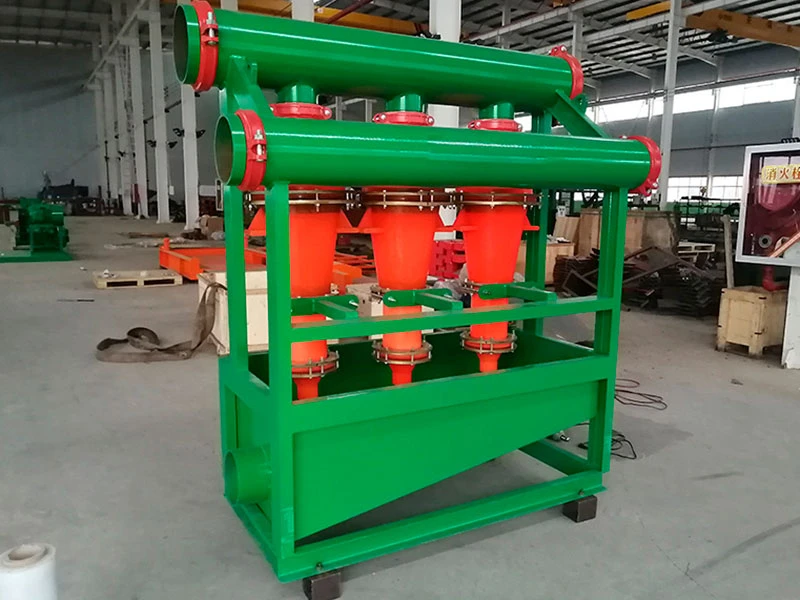
A desander for drilling rig serves as the traditional second-stage solids control equipment, positioning immediately downstream of the primary shale shaker. It targets larger hydrocyclone-manageable solids before the fluid moves to the desilter stage.
- Particle Separation Range: 45 to 74 microns.
- Equipment Configuration: It typically features a manifold of one to three 10-inch or 12-inch hydrocyclone cones mounted over a simple catch tank or frame.
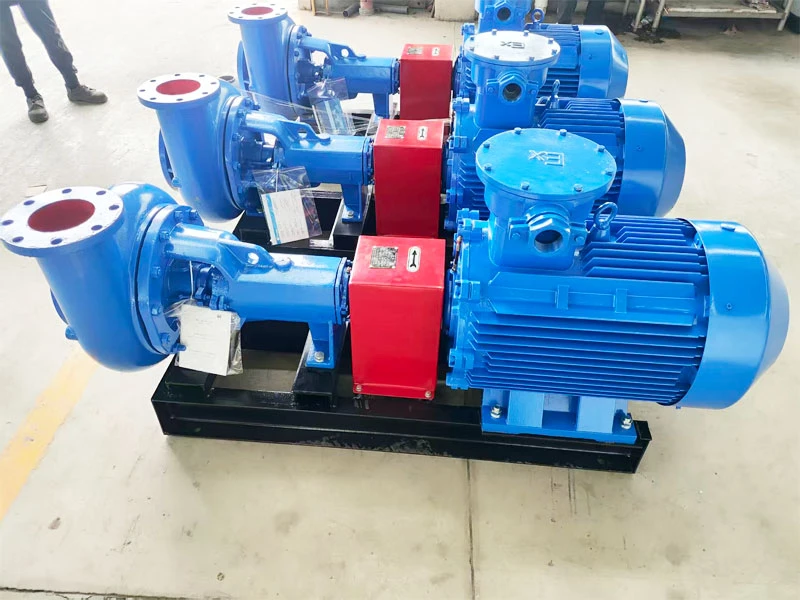
- Working Principle: A centrifugal pump feeds the treated mud from the shaker tank into the desander cones tangentially at a precise pressure. This velocity creates a powerful centrifugal vortex inside the cone. Heavier sand particles fling outward against the cone walls and spiral down through the bottom apex. The cleaned fluid moves upward through the center vortex finder and flows out from the top overflow.
- Best Used For: Unweighted drilling fluids (water-based muds, simple polymer fluids, and HDD/civil muds) where operators discard all underflow waste without financial concern over losing additives.
What is a Mud Cleaner?
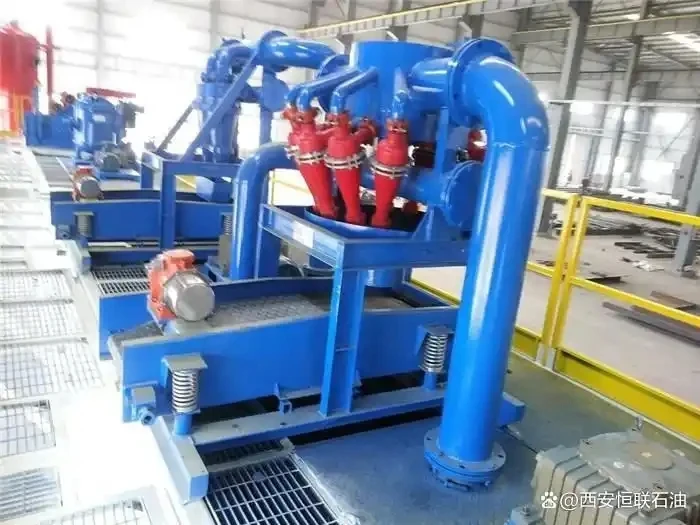
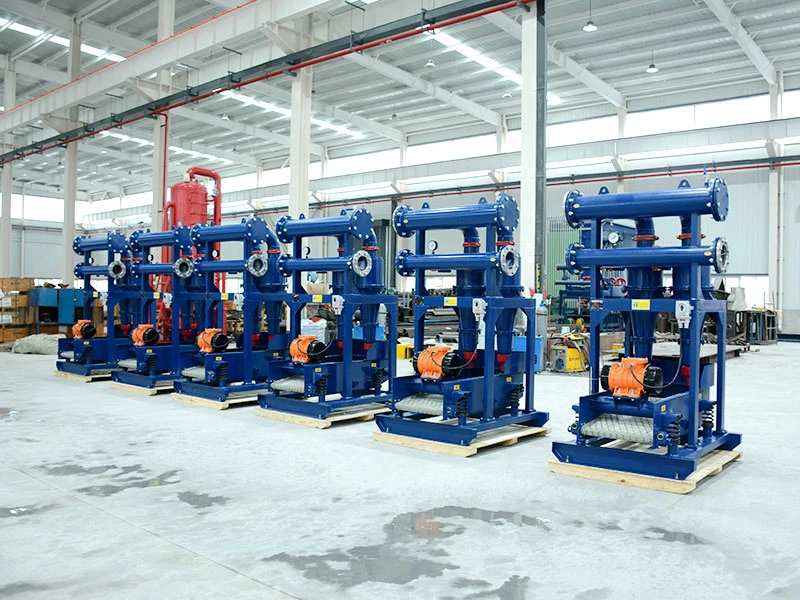
A mud cleaner represents an advanced, multi-stage separation unit. Instead of separating only one particle size class, it integrates second-stage desanding cones, third-stage desilting cones, and a high-frequency underflow shale shaker onto a single space-saving skid.
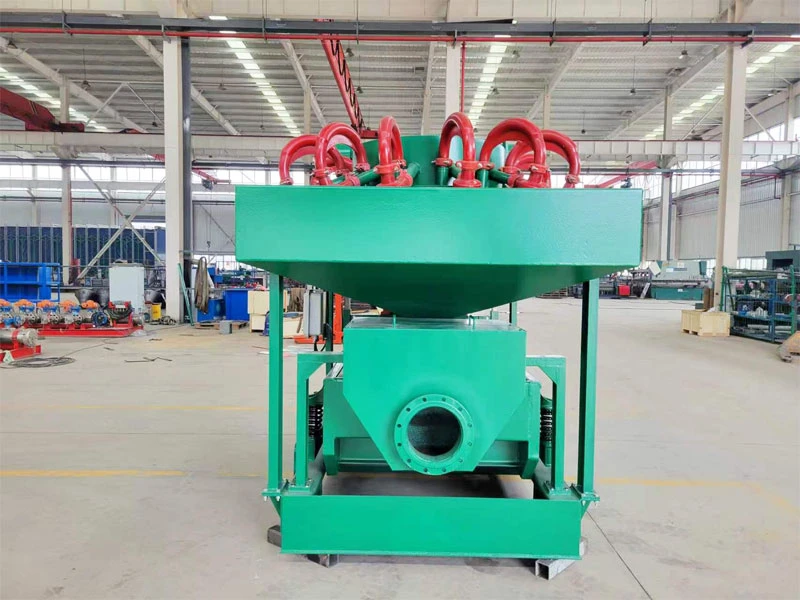
- Particle Separation Range: 15 to 74 microns (simultaneously processing sand and silt ranges).
- Equipment Configuration: A combination of 10-inch desander cones and 4-inch desilter cones positioned directly above a high-G, fine-mesh vibrating shale shaker.
- Working Principle: The hydrocyclones handle the initial volume-based liquid separation. However, instead of discarding the cone underflow directly into the waste pit, the mud cleaner drops this concentrated slurry onto a fine-mesh vibrating screen (typically 120 to 325 mesh). The high-G linear motion forces the valuable liquid and expensive weighting agents (like barite) through the screen meshes to return to the active mud system. Oversized drilled sand and silt remain on top of the screen and discharge as dry waste.
- Best Used For: Weighted drilling fluids and high-cost oil-based muds (OBM) where fluid preservation and barite retention remain top economic priorities.
Key Differences: Desander vs. Mud Cleaner
| Feature | Standalone Desander | Integrated Mud Cleaner |
| System Position | 2nd Stage Separation (Post-Shale Shaker) | Combines 2nd & 3rd Stages + Fine Screening |
| Cone Sizes | 10-inch or 12-inch cones only | Both 10-inch (Desander) and 4-inch (Desilter) cones |
| Cut Point Range | 45 – 74 Microns | 15 – 74 Microns |
| Mud System Suitability | Strictly Unweighted Mud Systems | Weighted Mud Systems & Oil-Based Mud (OBM) |
| Barite Recovery | None (Discards barite with sand) | Excellent (Recovers barite via underflow shaker) |
| Footprint & Piping | Requires separate spacing and piping layouts | Highly compact; integrates multiple stages on one skid |
Critical Decision Drivers
To determine whether to deploy a standalone desander or step up to a comprehensive mud cleaner, evaluate three operational variables:
1. Mud Density and Costly Additives (Barite Retention)
The presence of weighting materials dictates this choice. Barite particles generally range from 5 to 74 microns in size. If you feed weighted mud into a standard desander, the centrifugal force treats barite identically to sand, rejecting it out of the bottom apex. This causes massive material losses and spikes your fluid replenishment budget. A mud cleaner eliminates this issue. Its high-frequency underflow screen allows the 5-74 micron barite to pass right back into the system while screening out the larger solids.
2. Total Footprint on the Rig Deck
Standalone units require dedicated space for individual frames, manifold piping, and independent feeding pumps for both the desander and desilter stages. For offshore platforms, mobile drilling units, or highly restricted urban HDD worksites, a mud cleaner drastically reduces spatial constraints. Combining two hydrocyclone stages and an underflow shaker onto one frame saves up to 40% of the equipment footprint compared to modular layouts.
3. Environmental Regulations and Fluid Costs
A standalone desander continuously discharges a wet, fluid-heavy slurry. If you use expensive base fluids like diesel or synthetic oils (OBM), this liquid loss costs thousands of dollars daily. Furthermore, wet waste increases environmental haulage and treatment fees. The underflow shaker on a mud cleaner aggressively dries the solids, maximizing fluid reclamation and generating highly stackable, compliant waste cuttings.
Conclusion: Which One Best Fits Your Operation?
- Deploy a Standalone Desander if: You manage shallow drilling, water well construction, or standard HDD operations utilizing simple, inexpensive water-based mud where fluid loss does not impact project margins.
- Deploy a Mud Cleaner if: You conduct deep oil/gas exploration, run weighted fluids, utilize oil-based muds (OBM), face strict zero-discharge environmental mandates, or need to optimize equipment deck space.
At HL Petroleum, we manufacture robust, API-compliant Desanders and high-performance Mud Cleaners built to withstand demanding field conditions. Our engineering teams customize cone configurations, manifold layouts, and drilling shaker screen selections to match your precise geographical and geologic conditions.
Contact our solids control experts today to receive a comprehensive technical consultation and secure a competitive quote for your next mud system upgrade!